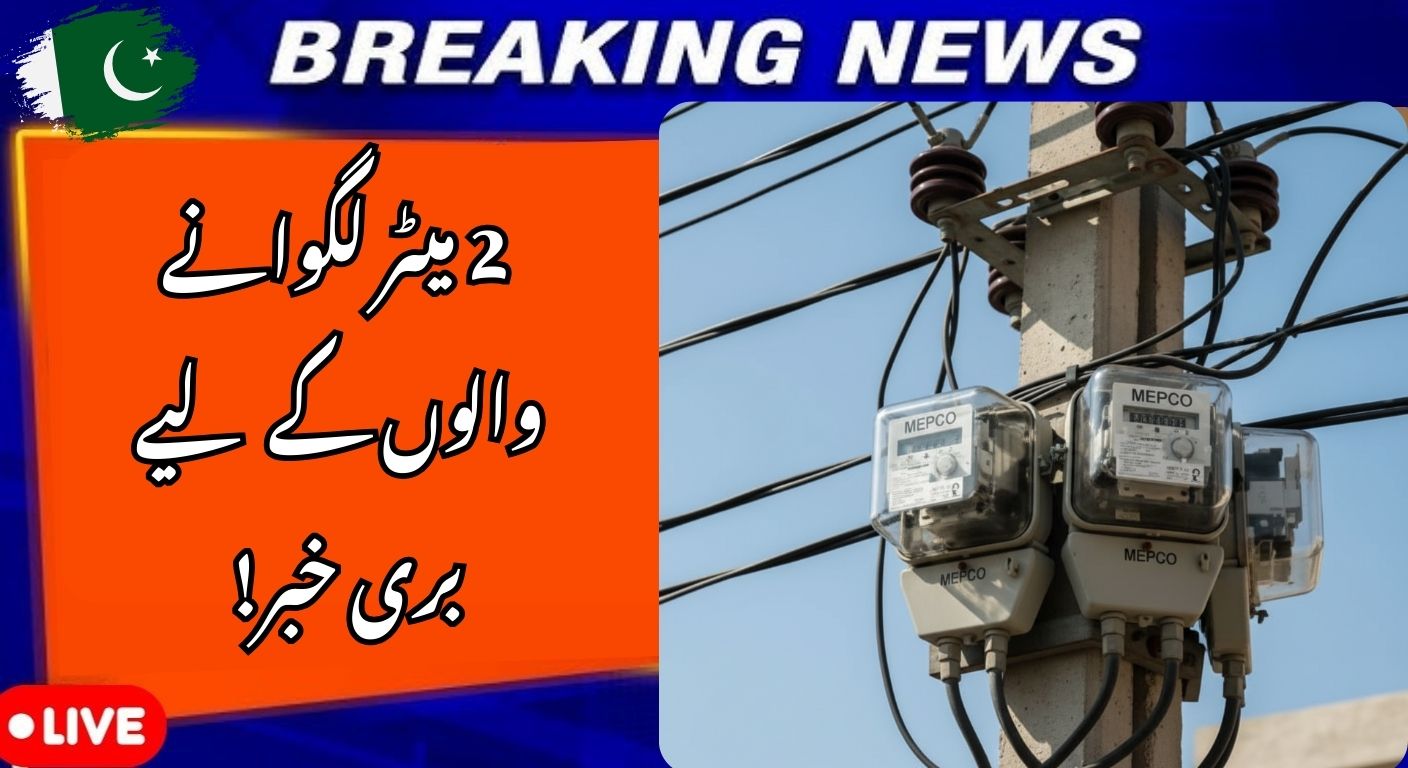
In 2026, the Water and Power Development Authority (WAPDA) along with Pakistan’s Power Division clarified the rules regarding multiple electricity meters in one house. This announcement came after widespread confusion and false claims on social media that WAPDA had banned extra meters.

The truth is that multiple meters are still allowed, but there are clear conditions and requirements that must be met before approval is given. This article explains everything — the new policy, how to apply, who can apply, required conditions, common myths, and why it matters for families and tenants across Pakistan.
Background: Why This Policy Is Important
In Pakistan, it is common for large families or multiple families to live in a single house. Sometimes extended families share one large home, or a house is divided into separate portions by tenants. Because of this living arrangement:

- One electricity bill often causes confusion.
- Families may struggle to share costs fairly.
- One household may use more electricity than others.
- Disputes can arise over billing and payments.
Previously, many people shared a single electricity meter, which could lead to conflict. To fix this confusion, WAPDA released a policy in 2026 that clearly defines when and how multiple electricity meters can be installed in one building.
Is the Social Media Rumor About a Ban True?
Recently, many social media posts claimed that:
- WAPDA has banned extra electricity meters.
- Electricity departments will no longer issue second or third meters.
- People will be forced to keep only one meter.
These claims are false.
Official government statements confirm that:

- Multiple meters are still allowed.
- There is no total ban on extra meters.
- Approval is now based on certain conditions.
- Fake social media news caused confusion.
This official clarification helped many residents understand their rights and avoid worries caused by incorrect online rumors.
What the 2026 WAPDA Policy Says
The official policy states that:
- Individuals can apply for more than one electricity meter at the same house.
- WAPDA or the relevant Distribution Company (DISCO) will only approve extra meters if the house truly has separate, independent living spaces.
- The policy applies to all electricity distribution companies in Pakistan, including:
- LESCO
- IESCO
- FESCO
- MEPCO
- PESCO
- K‑Electric
- SEPCO
This step aims to ensure that electricity billing is fair and transparent, reducing disputes between family members and tenants.
Why This Policy Matters
Previously:

- One electricity bill might serve an entire large household.
- Families or tenants shared costs often without clarity.
- Confusion frequently led to arguments.
The updated policy helps in multiple ways:
- Fair billing: Each portion or family gets its own bill.
- Transparency: Clear records of usage and costs.
- Conflict reduction: No arguments over shared electricity usage.
- Subsidy fairness: Only genuine households benefit from cheaper electricity slabs.
- Legal clarity: Clear rules help prevent illegal meter installations.
Are Multiple Electricity Meters Allowed in 2026?
Yes — Multiple electricity meters are allowed, but only when:
- The house has separate living units.
- Each unit is properly established with conditions required by WAPDA/DISCO.
Approval is not automatic; it depends on proper evidence and a documented process that verifies separate residences.
Conditions for Installing Extra Meters
To install a second, third, or additional electricity meter, the following conditions must be met:

1. Separate Portion
Each electricity meter must serve a fully independent living unit. A single room is not enough.
2. Separate Entrance
Each portion should ideally have its own entrance. Shared entrances may lead to rejection.
3. Separate Kitchen
A distinct kitchen is usually required to prove independent living.

4. Separate Electrical Wiring
Each portion must have its own wiring system separate from the main house wiring.
5. Legal Affidavit (if required)
In some cases, an affidavit confirming a separate household may be requested by WAPDA.
6. Physical Inspection
WAPDA or DISCO officials will inspect the property to confirm that it meets all requirements before approval.

Who Can Apply for an Extra Meter?
Both house owners and tenants can apply for extra electricity meters under the 2026 policy.
House Owners
Owners can apply directly if they can prove separate living units exist in the property.
Tenants
Tenants can also apply, but they must provide:
- Written permission from the owner
- A valid rent agreement
- Proof of separate living portion
This allows tenants to receive their own electricity bills and avoid disputes with landlords or other tenants.
Required Documents for Extra Electricity Meter Application
Before visiting a WAPDA or DISCO office, applicants should prepare the following:
- CNIC copy — for the applicant
- Ownership papers — if the applicant owns the property
- Rent agreement — if the applicant is a tenant
- Permission letter — from the owner (for tenants)
- Separate portion proof — such as photos or floor plan
- Electrical wiring layout — if asked
- Affidavit — if required by the office
Completing all documents accurately helps avoid delays or rejection.
How to Apply for an Extra Electricity Meter
The process is relatively simple as long as all conditions and documents are in place:
- Visit your local electricity office (WAPDA or DISCO branch).
- Request the application form for an extra meter.
- Fill in your details and attach required documents.
- Submit your CNIC, ownership/rent papers, wiring proof, and affidavit.
- Allow an official to inspect your property.
- Once approved, pay the meter security charges and connection fees.
- The new meter is installed after final approval.
This structured process ensures that only genuine cases receive extra meters and discourages illegal use.
Common Myths vs. Facts
| Myth | Fact |
|---|---|
| Only one meter is allowed per house | ❌ False |
| Extra meters will be removed | ❌ False |
| Tenants cannot apply | ❌ False |
| Government stopped issuing meters | ❌ False |
These myths have been circulating on social media, but official policy clearly states otherwise.
Benefits of Having Legal Multiple Meters
Legal, separate meters provide multiple advantages:
✔ Fair Billing
Each household pays only for the electricity it uses.
✔ No Conflicts
Separate bills prevent arguments among family members or tenants.
✔ Avoid Penalties
Illegal meters can lead to fines or disconnections. Legal meters keep you safe.
✔ Proper Use of Subsidies
Government electricity slabs and subsidized tariffs are applied fairly when meters are separate.
Why Some Applications Reject
Some extra meter requests may be rejected if:
- The unit doesn’t qualify as a separate living space
- Wiring is not independent
- Required documents are missing
- Officials find shared utilities during inspection
In such cases, revising evidence and meeting conditions can help re‑apply successfully.
Conclusion
According to the WAPDA Policy 2026, multiple electricity meters in one property are allowed — as long as each living unit is separate and meets the official requirements. There is no ban on extra meters, and social media rumors about cancellations are incorrect.
The updated policy brings clarity, fairness, and transparency to residential electricity billing in Pakistan. It helps families and tenants avoid confusion and conflict, ensures fair payment for usage, and safeguards proper use of subsidized electricity slabs.
If you plan to apply for an extra meter, make sure:
- Your portion is legally separate
- Documents are complete and correct
- You follow the official process
Approval becomes smooth and trouble‑free when rules are followed properly.